Your competitors may already be showing up where your customers are asking questions.
A potential customer no longer has to search Google, open ten websites and compare them manually.
They can ask:
“What are the best accounting software companies for a growing business?”
“Which SEO agencies specialize in SaaS?”
“What is the best event management software for corporate conferences?”
“Who provides destination management services in Australia?”
And increasingly, an AI-powered search experience can answer.
That creates a new visibility problem for businesses:
You may rank on Google and still be missing from the conversation happening inside AI search.
Google has expanded AI Overviews to more than 200 countries and territories, and Google says AI Overviews now have more than 2.5 billion monthly active users.
At the same time, ChatGPT can search the web, cite sources and send users to websites. OpenAI also explicitly provides guidance for website owners who want their content to be discoverable in ChatGPT search.
This means SEO is no longer only about ranking a blue link.
It is increasingly about becoming a trusted source that search engines and AI systems can understand, retrieve, cite and recommend.
That is where an AI Search Visibility Audit comes in.
What is an AI Search Visibility Audit?
An AI Search Visibility Audit evaluates how easily your brand, website, content and expertise can be discovered, understood, cited and recommended across AI-powered search experiences such as Google AI Overviews, Google AI Mode, ChatGPT, Gemini and Perplexity.
A traditional SEO audit asks:
“Can Google crawl, understand and rank this website?”
An AI search audit asks a broader question:
“When someone asks an AI system about the problem my business solves, does my brand have enough relevant, trustworthy and accessible information to become part of the answer?”
The two overlap—but they are not identical.
Why AI Search Visibility Matters Now
AI search is changing how people discover information.
Pew Research analyzed 68,879 Google searches from March 2025 and found that approximately 18% generated an AI summary. When an AI summary appeared, users clicked a traditional search result in only 8% of visits, compared with 15% when no AI summary appeared.
Even more striking: only 1% of visits resulted in a click on a link directly inside the AI summary.
This doesn’t mean traditional SEO is dead.
It means the search journey is changing.
Google itself says organic click volume has remained relatively stable year over year and reports that the clicks it sends can be higher quality.
Meanwhile, Semrush’s analysis of 17 months of clickstream data found that outbound referral traffic from ChatGPT to websites increased 206% from January 2025 to January 2026.
The opportunity isn’t simply “get AI traffic.”
It is:
Get your brand into the consideration set before the customer chooses someone else.
The 15-Point AI Search Visibility Audit
Use these 15 checks to determine whether your business is prepared for AI-driven discovery.
1. Search Your Brand in AI Platforms
Start with the simplest test.
Ask ChatGPT, Gemini, Perplexity and Google AI-powered search questions such as:
- Who are the best [your service] companies?
- What companies offer [your service]?
- What are the alternatives to [competitor]?
- Which [service providers] are recommended for [specific use case]?
- What should a company look for when choosing a [service] provider?
Then record:
| Check | What to record |
| Brand mentioned? | Yes / No |
| Recommended? | Yes / No |
| Position in answer | First / Middle / Last |
| Competitors mentioned | Who appears instead? |
| Source cited | Which websites support the answer? |
| Brand description | Is it accurate? |
| Differentiators | Are your strengths understood? |
Don’t test only your brand name.
Test the questions your potential customers actually ask.
2. Check Whether AI Understands What Your Business Does
AI systems need to understand your business entity clearly.
Your homepage should make these points obvious:
Who are you?
What do you offer?
Who do you serve?
Where do you operate?
What makes you different?
For example, don’t simply say:
“We help businesses grow online.”
That’s vague.
A stronger positioning statement might explain:
“Juggat Studio is an AI-powered SEO and digital growth studio helping businesses improve visibility across Google, ChatGPT, Gemini and emerging AI search experiences.”
The goal isn’t to stuff keywords.
It is to eliminate ambiguity.
3. Audit Your Entity Signals
AI search increasingly relies on connected information about entities, brands, people, products and organizations.
Check whether your brand information is consistent across:
- Website
- Google Business Profile
- Crunchbase
- Industry directories
- Social profiles
- PR mentions
- Review platforms
- Partner websites
- Author profiles
Look for inconsistencies in:
- Company name
- Description
- Services
- Location
- Founders
- Industry
- Website
- Contact information
Consistency builds clarity.
4. Check Whether Your Content Actually Answers Questions
AI search is particularly useful for conversational and complex queries.
Pew found that 53% of searches containing 10 or more words produced an AI summary, compared with only 8% of one- or two-word searches. Question-based searches were also especially likely to produce AI summaries.
That means your content shouldn’t only target:
“technical SEO”
It should also answer:
“How can technical SEO improve visibility for a SaaS website?”
Build content around the questions customers ask before, during and after choosing your service.
5. Check Your Content for Direct Answers
AI systems need extractable information.
Don’t bury the answer under five paragraphs of introduction.
Use:
- Short definitions
- Direct answers
- Bullet points
- Numbered processes
- Comparison tables
- Statistics
- Examples
- Clear headings
- Concise summaries
For example:
What is GEO?
Generative Engine Optimization (GEO) is the practice of improving a brand’s visibility and representation within AI-generated answers and generative search experiences.
Then explain it.
This structure is useful for humans and machine-readable retrieval.
6. Audit Your Expertise Signals
AI search optimization isn’t just about publishing more content.
Ask:
Why should an AI system—or a human—trust this website?
Look for evidence such as:
- Author expertise
- Years of experience
- Original research
- Case studies
- First-hand examples
- Expert commentary
- Client results
- Industry credentials
- Detailed service pages
- Transparent company information
Don’t manufacture authority.
Document real expertise.
If your team has worked on hundreds of SEO campaigns, explain the patterns you’ve observed.
If you have conducted original research, publish it.
If you’ve solved a difficult technical SEO problem, document the process.
That’s considerably stronger than another generic “10 SEO tips” article.
7. Audit Your First-Hand Experience
Experience is one of the easiest ways to differentiate content from generic AI-generated material.
Instead of writing:
“Internal linking is important for SEO.”
Explain:
“During technical audits, one recurring problem we see is important service pages receiving very few internal links from relevant commercial content. This can make those pages harder for both users and search engines to discover.”
The second statement demonstrates experience.
Add:
- Screenshots
- Examples
- Before/after results
- Processes
- Lessons learned
- Original observations
Show what you know rather than simply claiming expertise.
8. Find the Questions Your Competitors Answer—and You Don’t
Run a content gap analysis.
Compare your website with the brands appearing in:
- AI Overviews
- ChatGPT
- Gemini
- Perplexity
- Industry publications
- Relevant directories
Create a gap matrix:
| Topic | You | Competitor | AI visibility |
| Core service | ✓ | ✓ | High |
| Pricing questions | ✗ | ✓ | Medium |
| Comparisons | ✗ | ✓ | High |
| Implementation guides | ✓ | ✓ | Medium |
| Case studies | ✗ | ✓ | High |
| Industry-specific use cases | ✗ | ✓ | High |
The biggest opportunities often aren’t keywords.
They’re unanswered questions.
9. Audit Your Topical Authority
One article rarely establishes expertise around an important subject.
Build topic clusters.
For example, a digital agency targeting AI search could build:
AI Search Optimization
→ What is AI SEO?
→ What is GEO?
→ What is AEO?
→ ChatGPT SEO
→ Google AI Overviews
→ AI search visibility audit
→ How AI search citations work
→ Measuring AI visibility
→ GEO vs SEO
→ AI search optimization for SaaS
→ AI search optimization for local businesses
This creates a connected knowledge ecosystem.
10. Check Your Website’s Technical Accessibility
Before worrying about AI visibility, make sure your website can actually be discovered.
Audit:
- Robots.txt
- XML sitemap
- Indexability
- Canonicals
- Noindex directives
- JavaScript rendering
- Page speed
- Mobile usability
- Structured data
- Internal links
- HTTP status codes
- Orphan pages
For ChatGPT specifically, OpenAI says websites should not block OAI-SearchBot if they want their content to be eligible for discovery and citation in ChatGPT search.
Technical SEO remains foundational.
AI optimization doesn’t replace technical SEO. It builds on it.
11. Review Your Structured Data
Structured data helps communicate what a page represents.
Depending on your business, review relevant schema such as:
- Organization
- LocalBusiness
- Product
- Service
- Article
- BreadcrumbList
- FAQPage
- SoftwareApplication
- Event
- Person
But don’t add schema simply because it exists.
The markup should accurately describe visible, legitimate information on the page and follow the relevant search-engine guidelines.
12. Audit Your Brand’s Third-Party Mentions
Your website isn’t the only source of information about your business.
AI systems can encounter your brand through:
- Publications
- Reviews
- Directories
- Forums
- Partner websites
- Social platforms
- Industry associations
- Interviews
- Podcasts
- News coverage
Ask:
What does the internet say about my company when I’m not controlling the narrative?
This is particularly important for branded searches and recommendation queries.
If your website says one thing but ten authoritative third-party sources describe your company differently, you have an entity-consistency problem.
13. Measure AI Visibility—Not Just Rankings
Traditional SEO reporting usually focuses on:
- Rankings
- Organic traffic
- Impressions
- CTR
- Conversions
- Backlinks
AI search requires additional signals.
Track:
| Metric | What it tells you |
| AI mentions | Is your brand appearing? |
| AI citations | Are your pages being used as sources? |
| Recommendation frequency | Is AI recommending you? |
| Competitor share | Who appears instead? |
| AI referral traffic | Are AI platforms sending visitors? |
| Assisted conversions | Does AI contribute to leads? |
| Sentiment/accuracy | Is your brand represented correctly? |
| Query coverage | Which customer questions trigger visibility? |
Don’t obsess over one “AI ranking.”
AI responses can vary by query, user, location, freshness and platform.
Think in terms of visibility across a query set.
14. Check Whether Your Website Gives AI Something Worth Citing
This is where many websites fail.
A page that says:
“We provide high-quality SEO services to help businesses grow.”
doesn’t give much unique information.
A stronger page might include:
- Original statistics
- Methodology
- Industry-specific recommendations
- Expert insights
- Case studies
- Proprietary frameworks
- Examples
- Clear definitions
- Original research
- Transparent authorship
Ask:
If an AI system needed one trustworthy source on this topic, what would make it choose my page?
That’s the question modern content strategy should answer.
15. Test Your Competitors—Not Just Yourself
This is perhaps the most commercially important part of the audit.
Take your top five competitors and run the same prompts.
Create a visibility scorecard:
| Brand | Mentioned | Recommended | Cited | Strong positioning |
| Your brand | ✓ | ✗ | ✗ | ✗ |
| Competitor A | ✓ | ✓ | ✓ | ✓ |
| Competitor B | ✓ | ✓ | ✗ | ✓ |
| Competitor C | ✗ | ✗ | ✗ | ✗ |
Now ask:
What does Competitor A have that we don’t?
Maybe they have:
- More authoritative mentions
- Better service pages
- More detailed content
- Stronger topical coverage
- Better reviews
- More original research
- Better structured data
- Stronger brand/entity signals
- More relevant backlinks
That’s your AI visibility gap.
And that gap represents an opportunity.
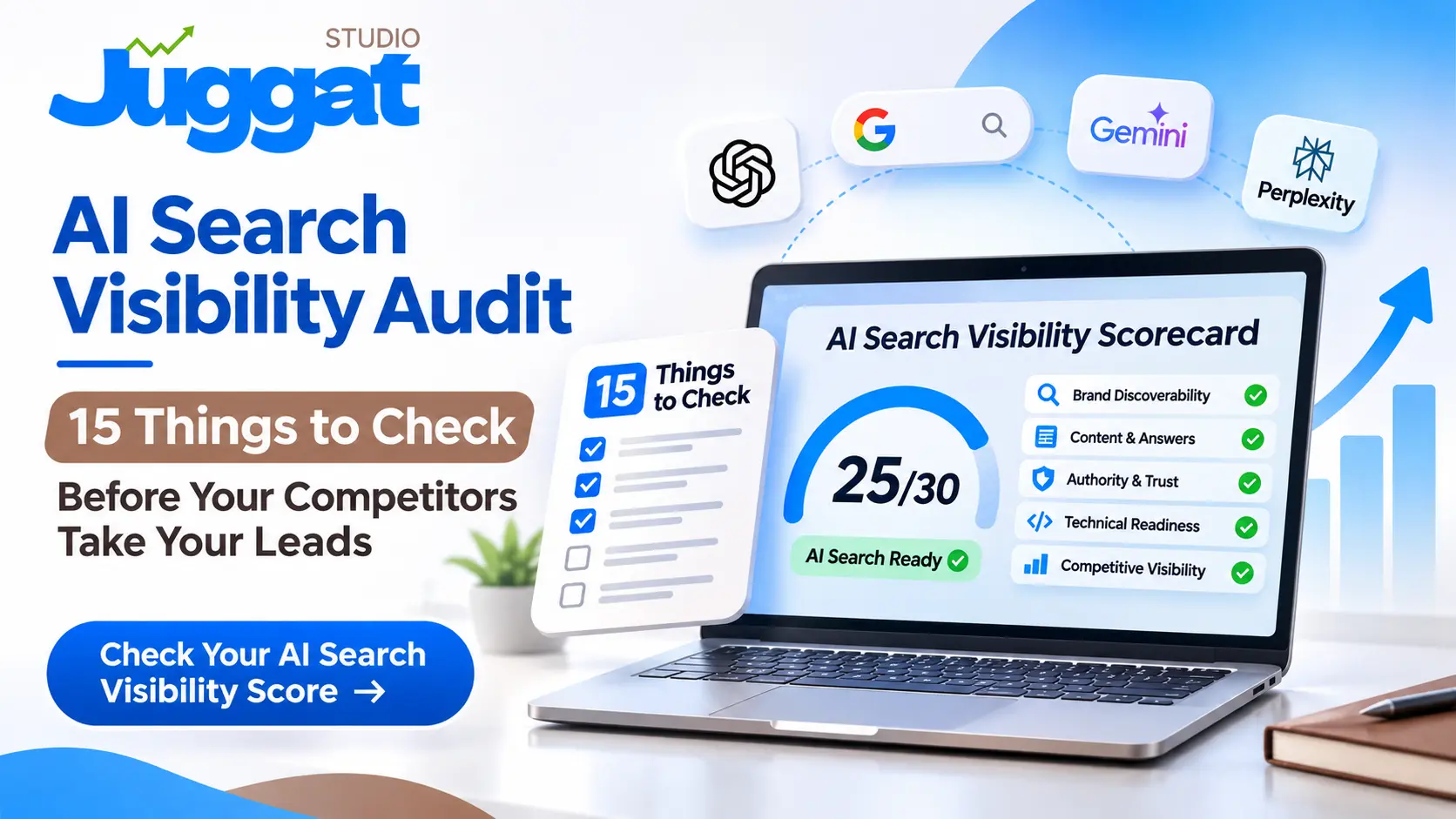
The AI Search Visibility Audit Checklist
Before you finish your audit, score each area from 0–2:
0 = Missing
1 = Needs improvement
2 = Strong
| Audit area | Score |
| Brand visibility | /2 |
| Business/entity clarity | /2 |
| Search intent coverage | /2 |
| Direct-answer content | /2 |
| E-E-A-T signals | /2 |
| First-hand experience | /2 |
| Content gaps | /2 |
| Topical authority | /2 |
| Technical SEO | /2 |
| Structured data | /2 |
| Third-party mentions | /2 |
| AI measurement | /2 |
| Citable content | /2 |
| Competitor visibility | /2 |
| Conversion pathways | /2 |
| Total | /30 |
How to interpret your score
25–30: AI-search ready
Your foundation is strong. Focus on expanding query coverage, authority and differentiation.
18–24: Significant opportunities
You have a foundation, but competitors may be capturing AI visibility you could be earning.
10–17: High-risk visibility gap
Your business may be difficult for AI systems to understand, trust or recommend.
0–9: Start with the fundamentals
Fix technical SEO, business/entity clarity, content quality and authority before chasing advanced GEO tactics.
This isn’t a universal industry benchmark. It’s a practical diagnostic framework for prioritizing work.
SEO Is Still Important. But SEO Alone Is No Longer the Whole Visibility Strategy.
There’s a temptation to describe AI search as the “death of SEO.”
That’s the wrong conclusion.
Google continues to send billions of clicks to websites and says organic click volume has remained relatively stable year over year.
The smarter approach is to connect:
SEO + AEO + GEO + Brand Authority + Content + Technical Accessibility + Conversion Optimization
Think of it this way:
SEO helps search engines find and rank you.
AEO helps you answer questions clearly.
GEO helps improve your visibility within generative search experiences.
Brand authority gives AI systems and users more reasons to trust you.
Together, they create a stronger search visibility strategy.
What Should You Do After an AI Search Audit?
Don’t try to fix all 15 areas simultaneously.
Prioritize the gaps that can influence business outcomes.
Priority 1: Fix visibility blockers
Resolve:
- Crawling problems
- Indexing issues
- Blocked AI/search crawlers
- Poor site architecture
- Missing important pages
- Incorrect structured data
Priority 2: Strengthen commercial content
Build pages around:
- Services
- Products
- Use cases
- Industries
- Comparisons
- Alternatives
- Pricing questions
- Buyer questions
Priority 3: Build authority
Invest in:
- Original research
- Digital PR
- Expert contributions
- Industry mentions
- Relevant backlinks
- Case studies
- First-hand experience
Priority 4: Build AI-query coverage
Monitor how your brand appears for real customer prompts.
Then improve the pages that should be supporting those answers.
Priority 5: Connect visibility to revenue
Ultimately, the objective isn’t:
“How many times did ChatGPT mention us?”
The better question is:
“Did our improved visibility help more qualified people discover, trust and choose us?”
Where Juggat Studio Fits In
AI search optimization isn’t about sprinkling a few “AI keywords” throughout a website.
It’s a much broader visibility problem.
Juggat Studio helps businesses understand how they are discovered across traditional search and AI-powered search—and what needs to change to improve that visibility.
Our approach brings together:
SEO
Technical and content foundations that help search engines understand your website.
AEO
Content structured around the questions customers actually ask.
GEO
Strategies designed to improve brand visibility within generative search experiences.
AI Search Visibility
Monitoring how your business appears across AI-powered discovery platforms.
Content Strategy
Building useful, authoritative content that answers real customer questions.
Digital Authority
Strengthening the signals that support trust, relevance and brand recognition.
The goal isn’t to chase every new AI platform.
It’s to build a digital presence that is easy to discover, easy to understand, worth citing and compelling enough to convert.
Ready to Find Your AI Search Visibility Gaps?
Your competitors don’t necessarily need better products to win the next customer.
They may simply need to be more visible at the moment that customer asks for a recommendation.
If your brand isn’t appearing when customers search, compare, research or ask AI for recommendations, there’s a visibility gap worth investigating.
Juggat Studio can audit your current AI search presence, identify where competitors are gaining visibility, and turn those gaps into a practical SEO + AEO + GEO growth strategy.
Get Your AI Search Visibility Audit →
Find out where your brand appears, where competitors are winning, and what you can do about it.
Frequently Asked Questions
1. What is an AI Search Visibility Audit?
An AI Search Visibility Audit evaluates how your brand appears across AI-powered search experiences such as Google AI Overviews, ChatGPT, Gemini and Perplexity, including mentions, citations, recommendations, content gaps and technical accessibility.
2. Is AI Search Optimization the same as SEO?
No. They overlap, but AI search optimization expands beyond traditional rankings. It considers how AI systems understand your brand, retrieve information, evaluate sources and generate recommendations or answers.
3. How do I know if my business is visible in ChatGPT?
Search ChatGPT using the questions your customers would ask when researching your products or services. Test your brand, competitors, category terms, use cases and recommendation queries, then record mentions, citations and recommendations.
4. Does ranking on Google guarantee visibility in AI search?
No. Strong Google rankings can help, but they don’t guarantee that an AI system will mention, cite or recommend your business. AI visibility depends on multiple signals, including relevance, accessible content, authority and how clearly your business can be understood.
5. Can Juggat Studio help improve AI search visibility?
Yes. Juggat Studio combines SEO, AEO, GEO, technical SEO, content strategy, authority building and AI-search visibility analysis to help businesses improve how they are discovered across traditional and AI-powered search.