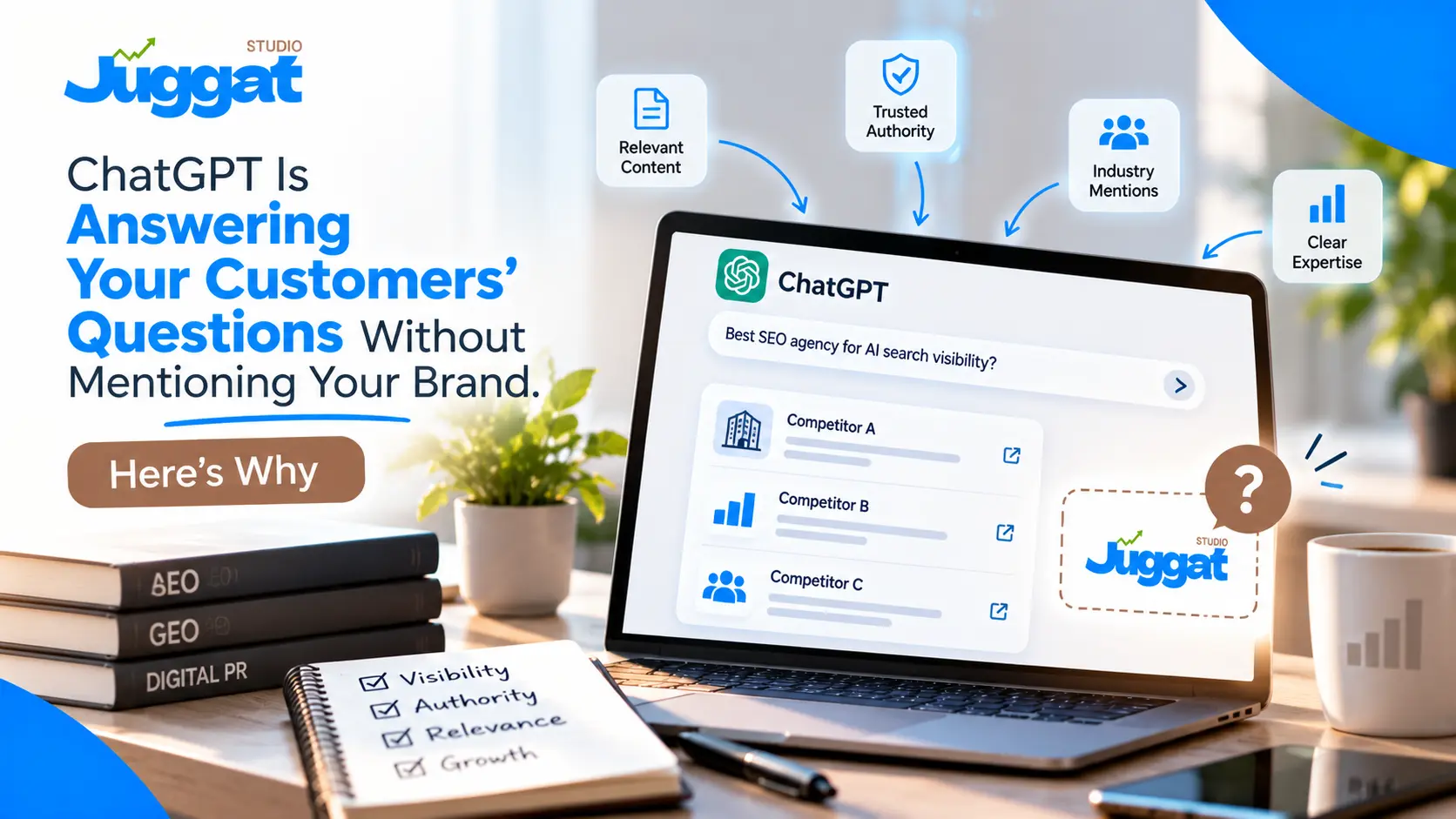
Imagine a potential customer asks ChatGPT:
“What’s the best SEO agency for a SaaS company?”
Your competitor appears.
You don’t.
Now imagine that customer asks:
“Which companies can help my business improve its visibility in AI search?”
Again, your competitor gets mentioned.
Your website may have excellent content. Your SEO team may have built hundreds of backlinks. Your pages may even rank well on Google.
So why isn’t the AI mentioning you?
Because being visible in traditional search and being understood, trusted and surfaced by AI systems are not exactly the same thing.
And this is becoming a real business problem.
Quick Answer: Why Doesn’t ChatGPT Mention My Brand?
ChatGPT may not mention a brand because AI search evaluates available information, relevance, credibility, context and sources differently from traditional Google rankings. Strong AI visibility requires more than keyword rankings—it requires clear brand information, topical authority, trustworthy third-party references, useful content and a technically accessible website.
Importantly, there is no guaranteed formula for getting ChatGPT to recommend a business. ChatGPT Search can search the web and provide citations, but OpenAI itself advises users to review cited sources because search results can be incomplete or incorrect.
1. Ranking on Google Doesn’t Automatically Make You an AI Recommendation
This is probably the biggest misconception.
Traditional SEO asks:
“Can Google rank this page for this query?”
AI search introduces another question:
“Does this information help answer the user’s actual question?”
Those aren’t identical.
Google says its AI search experiences continue to rely on the foundations of Search, while emphasizing unique, useful and non-commodity content.
So a business can rank for:
“SEO agency”
but still be missing when someone asks:
“Which SEO agency is good for a B2B SaaS company struggling with AI search visibility?”
The second query requires considerably more context.
2. AI Needs to Understand What Your Business Actually Does
Here’s a simple test.
Ask yourself:
If an AI system had to describe my company in one sentence, would it know exactly what makes us different?
If the answer is unclear, you have an entity and positioning problem.
Your website should clearly communicate:
- Who you help
- What you do
- Which problems you solve
- Which industries you understand
- What makes your approach different
- Where you operate
- What evidence supports your expertise
For example, saying:
“We provide digital marketing services.”
is weak.
Compare that with:
“We help B2B SaaS and service businesses improve visibility across Google, AI Overviews, ChatGPT and other AI-powered search experiences through technical SEO, AI Search Optimization and content authority.”
The second statement gives search systems considerably more context about the business.
3. Your Website Might Be Missing the Authority Signals AI Looks For
AI systems don’t live inside your website.
They encounter your brand across the wider web.
That includes:
- Industry publications
- Reviews
- Business directories
- Expert contributions
- Digital PR
- Partner websites
- Interviews
- Case studies
- Research
- Social profiles
- Community discussions
- Other authoritative websites
This is why Digital PR and authority building are becoming increasingly important alongside on-site SEO.
Your website says:
“We’re experts.”
But if nobody else appears to recognize that expertise, the claim is weaker.
Think of it this way:
Your website = what you say about yourself.
The wider web = what the internet says about you.
Strong AI visibility needs both.
4. You May Have Content—but Not the Content AI Needs
Publishing 50 generic blogs doesn’t automatically create authority.
Consider two websites.
Website A
- 100 generic SEO articles
- Rewritten industry definitions
- No original research
- No case studies
- No expert perspective
Website B
- 30 highly focused articles
- Original frameworks
- First-hand observations
- Customer examples
- Data and sources
- Detailed service expertise
- Strong internal linking
Website B may have significantly more useful evidence of expertise.
Google’s current guidance specifically encourages unique content that provides additional value rather than commodity content created simply to capture search traffic.
That principle matters for AI search too.
5. AI Citations and Brand Mentions Are Not the Same Thing
This is a fascinating—and commercially important—distinction.
A 2026 Semrush study analyzing thousands of domain appearances across AI search engines found that 62% of AI citations were “ghost citations”: the website was cited as a source, but the brand wasn’t explicitly mentioned in the answer.
That means:
Citation ≠ brand recognition.
You could potentially have:
Source: yourwebsite.com
without the AI actually saying:
“Your Brand is a good option.”
For businesses, that’s a crucial difference.
The goal shouldn’t simply be:
“Get cited.”
The larger goal is:
“Build enough authority and relevance that your brand becomes part of the answer.”
6. AI Search Is Becoming a Brand-Discovery Channel
Google itself says AI Overviews are helping people discover relevant websites, and in the U.S. and India, queries that trigger AI Overviews have seen more than a 10% increase in usage.
Google has also reported that people continue clicking into websites when they want to explore a topic, learn more or make a purchase, and that clicks from AI Search can be higher quality.
And Google is continuing to increase links inside its AI experiences, including inline links designed to make supporting sources easier to discover.
So the opportunity isn’t simply:
“Get traffic from AI.”
It’s:
Get discovered → build trust → get considered → generate demand.
7. A Real SEO Case Study Shows Why Foundations Still Matter
AI Search Optimization doesn’t replace technical SEO.
Google’s case study of Saramin, a major Korean employment platform, is a useful example.
After registering with Search Console and focusing initially on crawling and indexing problems, Saramin saw a 15% increase in organic traffic. Continued SEO improvements eventually contributed to a 102% year-over-year increase in organic traffic, alongside a 93% increase in new member sign-ups and a 9% increase in conversion rate during the reported period. This isn’t an AI Search case study—and we shouldn’t pretend it is.
But it demonstrates an important principle:
AI visibility cannot compensate for a technically weak website.
Your foundation still matters.
8. What Should You Do If ChatGPT Doesn’t Mention Your Brand?
Don’t immediately publish another 20 blogs.
First, diagnose the visibility gap.
Check these seven areas:
| Area | Question |
| Brand clarity | Is it obvious what you do and who you serve? |
| Topical authority | Do you demonstrate deep expertise in your category? |
| Content quality | Do you provide original value or repeat everyone else? |
| Entity signals | Is your business consistently represented across the web? |
| Authority | Are credible third parties mentioning you? |
| Technical SEO | Can search engines reliably crawl and understand your site? |
| Conversion | When someone discovers you, is there a clear next step? |
This is where SEO + AEO + GEO + Digital PR need to work together.
The Juggat Studio Approach: From Rankings to Recommendations
At Juggat Studio, we don’t believe AI Search Optimization means adding a few FAQs to a website and hoping ChatGPT notices.
We look at the bigger picture:
1. Search Visibility
Can search engines discover and understand your website?
2. AI Visibility
Can AI systems find useful information about your brand and expertise?
3. Authority
Does the wider web reinforce your expertise?
4. Content
Do you actually answer the questions your customers are asking?
5. Conversion
When someone discovers your brand, can they easily become a lead?
That’s the difference between optimizing content for AI and building a search visibility strategy for a business.
A Practical AI Visibility Checklist
Before expecting AI systems to recommend your business, make sure you can answer “yes” to most of these:
- My website clearly explains what my business does.
- My target customers are clearly defined.
- My core services have dedicated pages.
- My website demonstrates genuine expertise.
- I have original insights, case studies or research.
- My important pages are crawlable and indexable.
- My brand information is consistent across the web.
- Relevant third-party websites mention my business.
- My content answers commercial as well as informational questions.
- I track AI search visibility—not just Google rankings.
- My content leads users naturally toward a business action.
If most of these are missing, the problem probably isn’t “ChatGPT.”
It’s your overall digital authority.
The Bigger Shift: From Being Ranked to Being Recommended
For years, businesses asked:
“How do I rank #1 on Google?”
Now there’s another question worth asking:
“When my customers ask AI who they should consider, will my brand be part of the answer?”
That’s a much bigger strategic challenge.
And it requires more than traditional keyword optimization.
It requires technical SEO, useful content, topical authority, entity clarity, digital PR, trustworthy third-party signals and conversion-focused strategy working together.
At Juggat Studio, that’s the approach we call AI Search Optimization.
Don’t just optimize to be found. Build a brand worth recommending.
Want to know why AI search isn’t mentioning your brand? Reach out to Juggat Studio and get a free AI Search Visibility Audit for your website.
FAQs
1. Why doesn’t ChatGPT mention my business?
ChatGPT may not mention your business because it lacks enough relevant, trustworthy or accessible information to identify your brand as a strong answer for a particular query. Traditional Google rankings alone don’t guarantee AI recommendations.
2. Can I optimize my website specifically for ChatGPT?
There is no guaranteed ChatGPT ranking formula or special tag that makes a business appear in recommendations. The practical approach is to build technically accessible, useful, authoritative content and strengthen the broader online signals that establish your business’s relevance and credibility.
3. Does ranking on Google help with AI search visibility?
Yes, strong SEO fundamentals still matter. Google explicitly says its established SEO principles remain foundational to its AI search experiences, while emphasizing unique, useful content.
4. What is the difference between an AI citation and an AI brand mention?
An AI citation means your website is provided as a source. An AI brand mention means the AI explicitly names your business in its response. These can occur independently; Semrush’s 2026 study found a substantial share of AI citations did not include an explicit brand mention.
5. How can I improve my brand’s visibility in AI search?
Start with technical SEO and clear brand positioning, then build topical authority, original content, credible third-party mentions, digital PR and strong commercial pages. Finally, monitor how your brand appears—or fails to appear—across relevant AI queries and use those gaps to guide your strategy.