Getting to page one of Google is no longer the only visibility goal.
With Google AI Overviews, a page can be summarized inside an AI-generated answer and linked as a supporting source. That creates a new question for SEOs and marketers:
How does Google decide which websites to cite in an AI Overview?
The short answer is: Google does not simply select the #1 organic result.
Google’s own documentation says pages appearing as supporting links in AI Overviews must meet the normal technical requirements for Google Search: they need to be indexed and eligible to appear with a search snippet. Google also says there are no additional technical requirements specifically required for AI Overviews.
But eligibility is only the starting point.
Google’s AI systems can evaluate multiple relevant sources and, for complex questions, expand the original search into related sub-queries. This means a page that isn’t ranking #1—or even isn’t in the traditional top 10 for the exact query—can still become part of the AI-generated answer.
So, what actually makes a source worth citing?
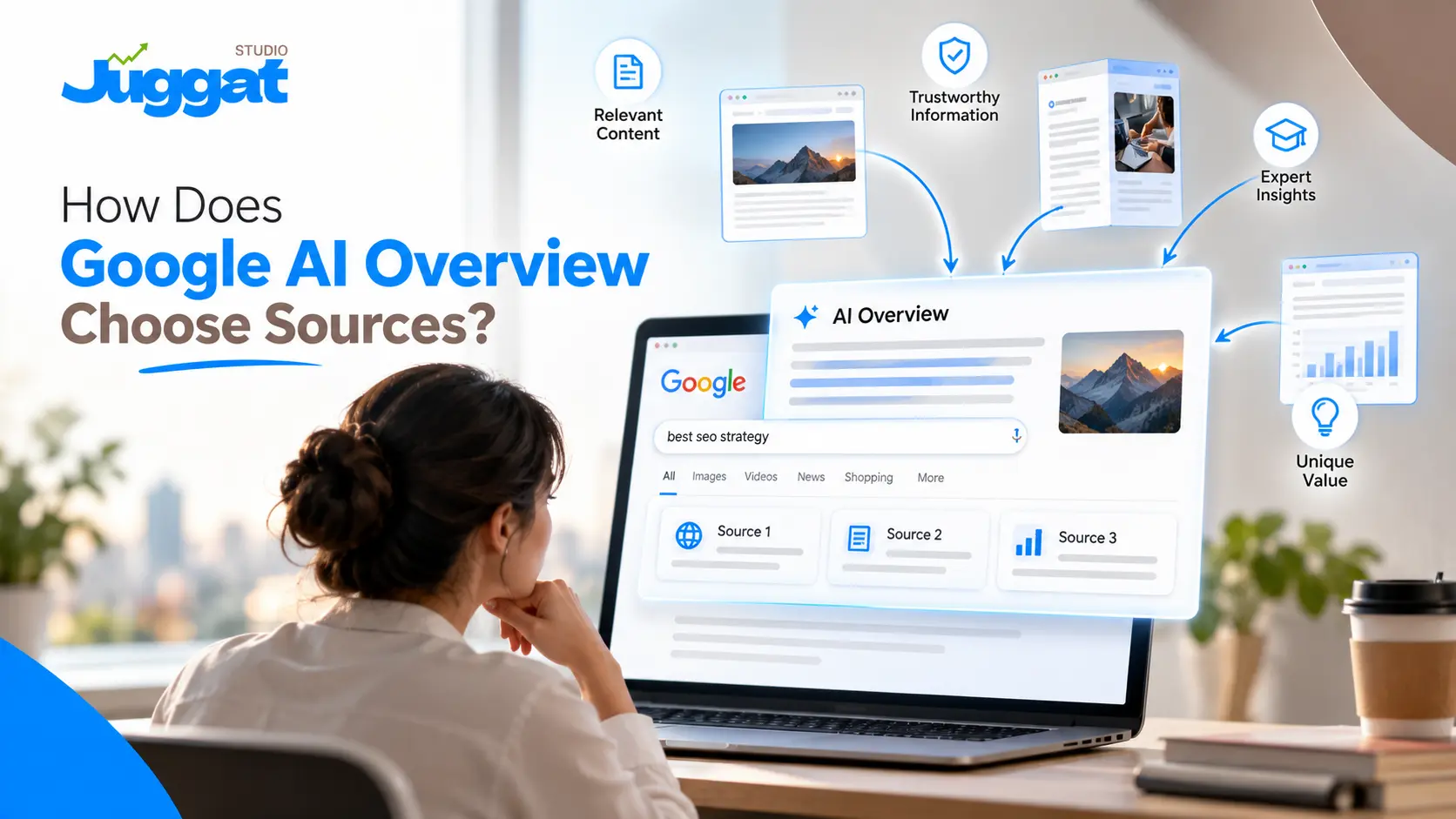
Quick Answer: How Does Google AI Overview Choose Sources?
Google AI Overviews choose sources based on relevance, usefulness, accessibility, and the quality of information available for the user’s query. Ranking well in traditional Search can help, but it does not guarantee an AI Overview citation. For AI visibility, create original, trustworthy, clearly structured content that directly answers specific user questions and supports important claims with credible evidence.
1. Google Starts With Search-Eligible Content
The first requirement is surprisingly simple.
Your page needs to be crawlable, indexable and eligible to appear in Google Search.
Google specifically states that a page must be indexed and eligible to be shown with a snippet to be considered as a supporting link in AI Overviews or AI Mode. There isn’t a separate “AI Overview schema” or special technical tag that guarantees inclusion.
That means your SEO fundamentals still matter:
- Crawlability
- Indexation
- Internal linking
- Relevant page structure
- Helpful content
- Search intent alignment
- Mobile usability
- Strong page experience
AI search hasn’t replaced SEO. It has expanded what SEO needs to accomplish.
2. Ranking #1 Helps—But It Doesn’t Guarantee a Citation
This is one of the biggest misconceptions about AI search.
A traditional Google ranking and an AI Overview citation are related, but they’re not identical.
Recent third-party research illustrates this clearly. A 2026 study of 321 unique cited URLs across SaaS searches found that only 33.2% of cited URLs also appeared in the traditional top 10 for the same query. The researchers also found that topical relevance had a stronger relationship with citations than Domain Rating in their dataset.
Another 2026 study analyzing 34,000 searches found that 92% of AI Overviews cited at least one page outside the traditional top 20 results.
These aren’t Google-confirmed ranking factors, so they shouldn’t be treated as Google’s official formula. But they reveal an important pattern:
Don’t optimize only for position. Optimize for being the best answer.
3. Query Fan-Out Changes the SEO Game
This is perhaps the most important concept behind Google’s AI search experience.
Google has publicly described query fan-out: instead of treating a complex question as one search, AI systems can break it into multiple related searches across different subtopics and sources.
Imagine someone searches:
“What’s the best SEO strategy for a SaaS company trying to appear in ChatGPT and Google AI Overviews?”
Google may need information about:
- SaaS SEO
- AI search optimization
- Google AI Overviews
- Technical SEO
- Content strategy
- Entity authority
- AI search visibility
Your page doesn’t necessarily need to rank for the entire question.
It can become valuable because one section provides the strongest answer to one of the underlying questions.
This changes your content strategy:
Instead of creating one article targeting one keyword, build topic clusters that answer the entire decision journey.
4. Relevance Can Beat General Authority
A huge website isn’t automatically the best source.
Imagine two pages:
| Website | Content |
| Large general marketing website | One short article about technical SEO |
| Specialist SEO agency | 2,000 words covering technical SEO in depth with examples and original analysis |
For a highly specific technical SEO question, the specialist page may provide a more useful answer.
Google’s own guidance emphasizes unique, satisfying and people-first content, rather than content created simply to manipulate search rankings.
This is particularly important for GEO.
Think:
Topical relevance > generic popularity
Your website should demonstrate that it actually understands the subject it wants to be cited for.
5. Clear Answers Are Easier for AI Systems to Use
AI-generated search experiences need to understand content quickly.
That doesn’t mean writing robotic content for machines.
It means making your expertise easy for both humans and search systems to understand.
For example, instead of beginning an article with 500 words of generic introduction:
“In today’s rapidly evolving digital landscape…”
Answer the question immediately.
Better:
Google AI Overviews do not require a special optimization tag. A page must first be indexed and eligible to appear in Google Search, while useful, relevant and trustworthy content increases its potential to be surfaced as a supporting source.
Then explain why.
This structure works well for:
- Featured snippets
- AI Overviews
- Voice search
- AEO
- GEO
- Human readers
6. Original Information Gives Your Content Something to Cite
This is where many AI-search strategies fall short.
If your article simply rewrites information already available on 20 websites, why should an AI system choose your page?
Give it something distinctive.
For example:
- Original research
- First-hand observations
- Proprietary data
- Expert commentary
- Customer examples
- Screenshots
- Original frameworks
- Case studies
- Comparisons
- Experiments
- Clearly sourced statistics
Google’s current guidance explicitly encourages creators to produce unique, non-commodity content that provides additional value. Google for Developers
7. E-E-A-T Still Matters
E-E-A-T stands for:
Experience → Expertise → Authoritativeness → Trustworthiness
Google explains that E-E-A-T itself isn’t a single ranking factor, but its systems use a variety of signals that help identify content demonstrating these qualities. Google also says trust is the most important element within E-E-A-T. Google for Developers
For AI search, this becomes especially important.
If you’re making a claim about:
- SEO
- Finance
- Healthcare
- Law
- Security
- Technology
- Business performance
don’t simply make the claim.
Show where it came from.
Use:
- Primary sources
- Official documentation
- Recognized research
- Expert quotes
- First-hand experience
- Transparent methodology
Real-World Evidence: What Google Says About AI Search
Google’s own data provides some useful evidence about how AI search is changing discovery.
In May 2025, Google reported that AI Overviews were driving more than a 10% increase in Google usage for the types of queries that show AI Overviews in the U.S. and India.
Google also reported that clicks from search pages containing AI Overviews can be higher quality, with visitors more likely to spend time on the websites they visit.
And in August 2024, Google said its experiments with links directly within AI Overviews showed higher traffic to publisher websites.
These findings reinforce an important point:
Being cited isn’t only about visibility. It can become a new discovery and conversion opportunity.
So, What Makes a Page Citation-Worthy?
Think of AI visibility as a combination of six elements:
| Signal | What to do |
| Relevance | Answer the exact user problem |
| Topical depth | Build authority around a subject |
| Clarity | Put direct answers near relevant questions |
| Originality | Add research, experience or unique insights |
| Trust | Cite credible primary sources |
| Technical SEO | Make the content crawlable and indexable |
None of these guarantees an AI Overview citation.
And that’s important.
There is no legitimate “AI Overview hack.”
Google explicitly says there are no additional technical requirements specifically for appearing in AI Overviews.
How Juggat Studio Approaches AI Search Optimization
At Juggat Studio, we don’t view AI search as a replacement for SEO.
We see it as the next layer of search visibility.
That means combining:
Technical SEO + Search Intent + Topical Authority + E-E-A-T + AEO + GEO + Original Content
The goal isn’t simply to rank a page.
It’s to create content that is strong enough to become a source when Google, ChatGPT, Gemini, Perplexity or another AI system is looking for an answer.
Because the future of search isn’t only:
“Where do I rank?”
It’s increasingly:
“Does the AI trust my website enough to recommend it?”
And that’s a much more valuable question for brands competing for visibility in AI-powered search.
Final Takeaway
Google AI Overviews don’t appear to follow a simple “rank #1 → get cited” formula.
The strongest strategy is to build content that is:
Technically accessible → highly relevant → genuinely useful → clearly structured → evidence-backed → trustworthy → uniquely valuable.
Traditional SEO gets your content into Google’s ecosystem.
AEO and GEO help you make that content easier to understand, extract, cite and recommend across AI-driven search experiences.
That is the real shift from ranking for search to earning visibility in answers.