
Search is no longer limited to typing a keyword into Google and choosing one result from a list.
People can now ask longer questions directly to Google AI features, ChatGPT, Gemini and other AI-powered search experiences and receive a synthesized response built from multiple sources.
That changes an important part of digital visibility.
A business doesn’t only need a page that can rank. It also needs information that search and AI systems can find, understand, evaluate and use accurately.
That’s where AI Search Optimization comes in.
AI Search Optimization is the process of improving a brand’s content, website and broader digital presence so that AI-powered search systems can discover, understand and potentially surface or cite that information when answering relevant user questions.
It does not replace SEO. In practice, much of the technical foundation is shared.
What changes is the search experience—and therefore the way businesses need to think about visibility.
What is AI Search Optimization?
AI Search Optimization is an umbrella term for improving a business’s visibility across AI-powered search and answer experiences.
Depending on the platform and industry, you may also encounter terms such as:
- AEO — Answer Engine Optimization
- GEO — Generative Engine Optimization
- AI SEO
- LLMO — Large Language Model Optimization
These terms overlap substantially, although different practitioners use them with slightly different emphasis. Current industry guides from HubSpot, Semrush and specialist AI-search agencies generally describe the goal as improving the likelihood that a brand or its content is surfaced, mentioned or cited in AI-generated answers.
For Juggat Studio, AI Search Optimization is the broader service concept.
AEO and GEO are methodologies within that broader discipline—not separate magic systems that replace SEO.
In simple terms:
Traditional SEO asks:
How can this page become more visible in search results?
AI Search Optimization asks:
How can this business become easier for AI-powered search systems to discover, understand, trust and accurately represent?
Both questions matter.
How is AI Search different from traditional search?
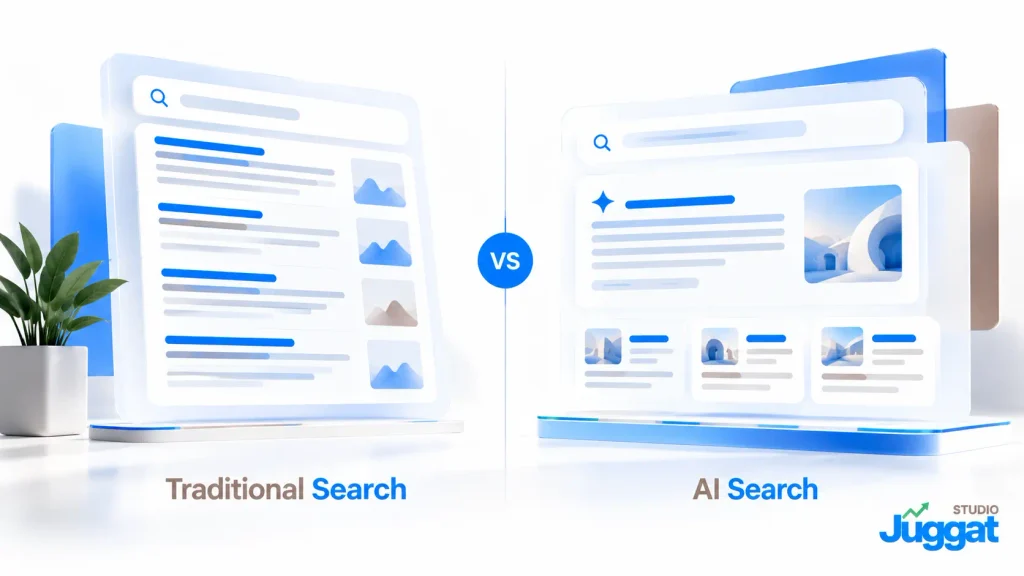
Traditional search generally presents a ranked collection of links.
AI-powered search can instead synthesize information from multiple sources and present a conversational answer.
For example, instead of searching:
- best technical SEO agency
a user might ask:
I’m a B2B SaaS company with a technically complex website. What should I look for when choosing an SEO agency, and which agencies specialize in technical SEO?
The second query contains several underlying questions:
- What makes a technical SEO agency suitable for SaaS?
- Which capabilities matter?
- What problems should the agency be able to solve?
- Which companies have relevant evidence?
- What differentiates one provider from another?
Modern AI search experiences can handle this kind of more complex exploration. Google has described AI Mode as being designed for deeper and more conversational searches, including questions that would traditionally require multiple searches.
This means businesses need to think beyond individual keywords.
They need to build clear, connected and trustworthy information around the questions their audience actually asks.
How does AI Search Optimization work?
There isn’t one universal AI-search ranking formula.
Google, OpenAI and other platforms use different systems, and their internal selection mechanisms aren’t fully public.
However, the practical process can be understood through several stages.
1. Your content needs to be discoverable
An AI system cannot reliably use information it cannot access.
For Google Search, that means making important pages crawlable and indexable.
For ChatGPT Search, OpenAI specifically states that publishers should avoid blocking OAI-SearchBot if they want their content to be included in ChatGPT Search summaries and citations.
This makes technical accessibility the first layer of AI Search Optimization.
That includes fundamentals such as:
- crawlable pages
- indexable content
- sensible internal links
- accessible text
- functioning canonical URLs
- XML sitemaps
- appropriate robots.txt configuration
- fast, usable pages
- mobile accessibility
These aren’t “AI tricks.”
They’re good technical SEO.
And they remain important.
2. Search systems need to understand what your page is about
Being accessible isn’t enough.
Your content also needs to communicate its subject clearly.
Consider a page about technical SEO.
A vague heading such as:
Making Your Website Better
doesn’t communicate much.
A clearer structure would use headings such as:
- What Is Technical SEO?
- How Crawling Works
- How Indexing Works
- Common Technical SEO Problems
- How to Conduct a Technical SEO Audit
Clear terminology and logical organization make information easier for both people and machines to interpret.
This is one reason answer-first content works well.
If a page is answering a specific question, answer the question clearly before expanding into the details.
3. AI systems need useful information to retrieve
This is where content quality becomes important.
Suppose someone asks:
What is the difference between SEO and AI Search Optimization?
A weak article might spend 500 words talking about how “search is changing.”
A useful article would immediately explain the distinction, then provide:
- definitions
- similarities
- differences
- examples
- limitations
- practical implications
The objective isn’t to write more.
It’s to make the relevant information easy to retrieve and understand.
Google’s people-first guidance emphasizes original, useful information rather than content produced primarily to manipulate rankings.
4. Your brand needs to be understandable as an entity
AI Search Optimization isn’t only about individual articles.
AI systems also need to make sense of who the business is.
For example:
Juggat Studio
should consistently be represented as a digital growth studio specializing in areas such as:
- AI Search Optimization
- SEO
- Technical SEO
- Local SEO
- Ecommerce SEO
- Content Marketing
- Digital PR & Authority Building
- Website Design & Development
- CRO
That information should be consistent across the website and relevant external sources
Google’s Organization structured-data guidance specifically explains that organization information can help Google understand and disambiguate an organization.
This doesn’t mean adding a pile of schema and expecting an AI system to trust you.
It means building a consistent digital identity.
5. Authority extends beyond your own website
One of the biggest misconceptions about AI Search Optimization is that everything can be fixed by changing your own website.
It can’t.
When people ask AI systems for recommendations, the answer may depend on information from many places across the web.
That means a business’s broader digital presence matters.
Relevant signals can include:
- industry publications
- reputable directories
- partner websites
- professional organizations
- news coverage
- expert contributions
- reviews
- third-party references
- original research
- authoritative mentions
This is one reason Juggat Studio treats Digital PR & Authority Building as a complementary service rather than simply selling backlink volume.
The objective should be to build a credible web presence around the brand.
6. Original information can make your content more valuable
This is where many AI-search articles fall short.
If ten websites repeat:
AI Search is changing SEO.
the eleventh website doesn’t become valuable simply by saying the same thing with different wording.
Instead, add something useful.
For example:
A practical AI visibility framework
| Layer | Question |
| Discoverability | Can search systems access the important information? |
| Clarity | Is it obvious what the business does and who it serves? |
| Content | Does the site answer important customer questions? |
| Evidence | Are claims supported by credible information? |
| Authority | Do relevant third-party sources reinforce the brand? |
| Consistency | Is the business represented consistently across the web? |
| Measurement | Can changes in visibility be monitored? |
This is more useful than another generic list of “10 AI SEO tips.”
SEO, AEO and GEO: Are they actually different?
| SEO | AEO | GEO | |
| Primary focus | Search visibility | Direct answers | AI-generated responses |
| Typical output | Search results | Answer/result | Synthesized response |
| Foundation | Technical + content + authority | Clear answers + structure | Content + authority + retrieval |
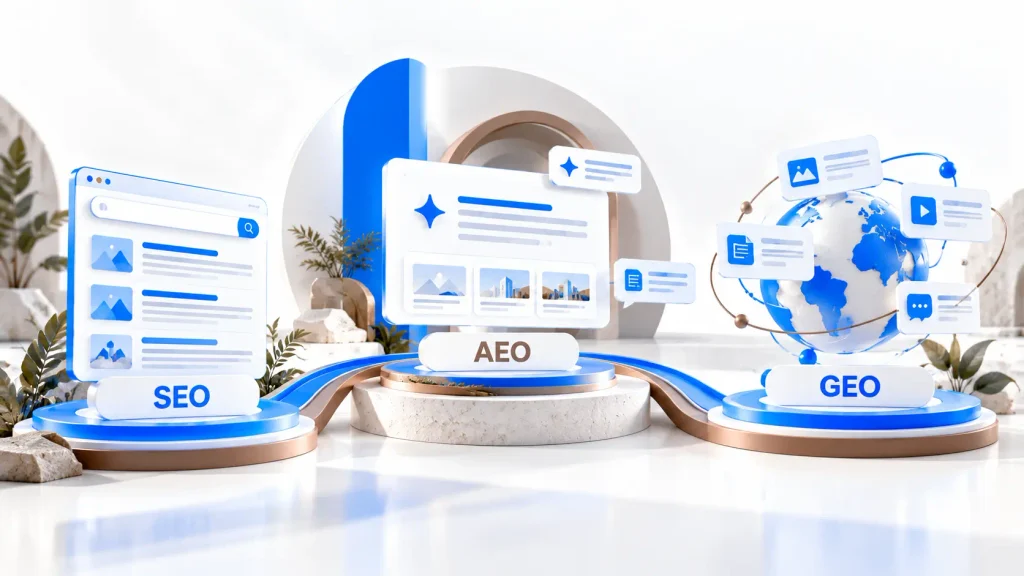
You will see many articles presenting these as completely separate disciplines.
The reality is more nuanced.
SEO
Search Engine Optimization focuses on improving organic search visibility through technical accessibility, content, relevance, links, user experience and other established search practices.
AEO
Answer Engine Optimization generally emphasizes making information easy for answer-oriented systems to retrieve and present as direct answers.
GEO
Generative Engine Optimization generally emphasizes visibility within generated responses and the sources those systems use.
AI Search Optimization
AI Search Optimization can be used as the broader business-facing term covering optimization for AI-powered search experiences.
The terminology isn’t standardized across the industry. Recent specialist research and agency guides use these terms with overlapping definitions.
So businesses should focus less on choosing the “correct acronym” and more on the actual work:
Make the right information accessible, understandable, credible and useful wherever your customers search.
What should businesses optimize for AI Search?
A practical AI Search Optimization program should cover several layers.
Technical foundation
Make sure important content can be discovered and accessed.
Check:
- robots.txt
- XML sitemap
- indexability
- canonicalization
- internal linking
- JavaScript accessibility
- page performance
- mobile usability
- structured data where appropriate
Google’s documentation emphasizes that pages used in Search features need to be crawlable and accessible, and recommends testing important pages through URL Inspection.
Content quality
Create content that genuinely answers customer questions.
Prioritize:
- direct answers
- original research
- practical examples
- comparisons
- first-hand insights
- useful frameworks
- accurate data
- clear explanations
- transparent limitations
Avoid creating dozens of pages simply to target slight variations of the same question.
Entity clarity
Make it easy to understand:
- who you are
- what you offer
- who you serve
- where you operate
- what you specialize in
- which products/services belong to your organization
Keep these facts consistent across your website and relevant external profiles.
Authority
Build credible references around your business.
This might include:
- Digital PR
- expert contributions
- industry publications
- partnerships
- relevant directories
- original research
- legitimate mentions
- useful resources others want to reference
The goal isn’t to accumulate the largest number of links.
It’s to build a credible information ecosystem around the brand.
What AI Search Optimization cannot guarantee
This is an important distinction.
No legitimate SEO or AI-search agency can guarantee that:
- ChatGPT will recommend your company
- Gemini will cite your article
- Google will show your page in an AI Overview
- your business will be recommended for every relevant question
- a particular page will receive a specific number of AI citations
Search and AI systems make their own retrieval and ranking decisions.
Google explicitly says there are no special requirements or special schema required to appear in AI Overviews or AI Mode. The underlying SEO fundamentals remain important.
OpenAI similarly explains that public websites can appear in ChatGPT Search and that crawler access matters, but that isn’t a guarantee of citation for a particular query.
That makes visibility improvement a better objective than promising “AI rankings.”
How should you measure AI Search visibility?
Traditional SEO metrics still matter:
- organic impressions
- clicks
- CTR
- rankings
- indexed pages
- conversions
- qualified leads
But AI Search introduces additional questions:
- Is the brand mentioned in relevant AI answers?
- Which pages are cited?
- Which topics generate visibility?
- Is the brand described accurately?
- Which third-party sources appear alongside the brand?
- Are AI-referred visitors reaching the website?
- Do those visitors engage or convert?
Google has also continued expanding Search Console reporting around AI features, including AI Mode and AI Overviews within Search performance reporting.
That means AI-search visibility can increasingly be treated as something to measure, not simply speculate about.
A practical AI Search Optimization framework
For most businesses, the process can be simplified to seven steps:
1. Audit
Understand how the brand currently appears across search and AI experiences.
2. Fix accessibility
Make important information crawlable, indexable and technically accessible.
3. Clarify the entity
Create consistent information about the organization, products and services.
4. Build useful content
Answer the questions customers actually ask, including complex and conversational questions.
5. Add information gain
Provide original analysis, examples, research, frameworks or evidence competitors don’t provide.
6. Build authority
Strengthen the brand’s presence through relevant, credible third-party sources.
7. Measure and improve
Monitor search visibility, AI visibility, citations, traffic and business outcomes—and use what you learn to prioritize the next improvements.
This is not a one-time optimization.
AI search interfaces, user behaviour and retrieval systems continue to change.
Does AI Search Optimization replace SEO?
No.
For most businesses, the better approach is to build AI Search Optimization on top of strong SEO fundamentals.
A technically inaccessible website cannot become a strong source simply because it has an AI-focused content strategy.
Likewise, a website with technically perfect SEO but weak, generic information may struggle to become a useful source for complex questions.
The two disciplines therefore overlap heavily.
Think of it this way:
SEO helps search systems discover and evaluate your website. AI Search Optimization expands the goal to making your information useful, understandable and credible within AI-mediated search experiences.
The strongest strategy isn’t choosing between them.
It’s connecting them.
Why AI Search Optimization matters now
The search journey is becoming more conversational.
A customer may discover a business through:
Google Search → AI Overview → website
or:
ChatGPT → cited source → website
or:
Google AI Mode → follow-up question → multiple sources → website
or through a combination of traditional search, social content, reviews, publications and AI-generated recommendations.
Google has continued expanding its AI-powered Search experience, while OpenAI provides dedicated guidance for publishers whose content may appear in ChatGPT Search.
That doesn’t make traditional search obsolete.
It means search visibility now has more surfaces.
Businesses that build clear, useful and authoritative digital information can participate across more of those surfaces.
The bottom line
AI Search Optimization isn’t about finding a secret formula that makes ChatGPT, Gemini or Google recommend your company.
It’s about building a digital presence that is:
discoverable → understandable → useful → credible → consistently represented.
The fundamentals still matter:
- Technical SEO makes information accessible.
- Content strategy answers real questions.
- Entity optimization makes the business understandable.
- Digital PR and authority building strengthen credibility.
AI Search Optimization brings these elements together around the way modern search experiences discover and present information.
And the most sustainable approach is not to create content for an algorithm.
It’s to create information that deserves to be found.
Frequently Asked Questions
What is AI Search Optimization?
AI Search Optimization is the practice of improving a brand’s website, content and digital presence so AI-powered search systems can discover, understand and potentially surface or cite its information in relevant answers.
Is AI Search Optimization the same as SEO?
No. They overlap substantially, and SEO remains an important technical and content foundation. AI Search Optimization focuses more explicitly on visibility within AI-mediated search and answer experiences.
Is GEO the same as AI Search Optimization?
GEO and AI Search Optimization are overlapping terms. Different practitioners define them differently, so the underlying work is more important than the acronym.
Can you guarantee a ChatGPT citation?
No. AI systems make their own retrieval and response decisions. Optimization can improve discoverability and the quality of information available to those systems, but it cannot guarantee a citation.
Does AI Search Optimization replace Google SEO?
No. Strong technical SEO, useful content, crawlability, internal linking and authority remain important foundations for modern search visibility.
What businesses should do next

If your website already has solid SEO foundations, the next step isn’t to publish hundreds of AI-focused articles.
Start by identifying the questions your customers ask, auditing how your brand currently appears across search and AI experiences, and finding the information gaps your competitors haven’t addressed.
That is where an AI Search Optimization strategy becomes practical rather than theoretical.
Juggat Studio helps businesses build search visibility beyond traditional rankings through AI Search Optimization, SEO, technical SEO, content strategy and digital authority building.
Explore: AI Search Optimization service
Learn more about: Juggat Studio
Discuss your search visibility: Contact Juggat Studio
One Response