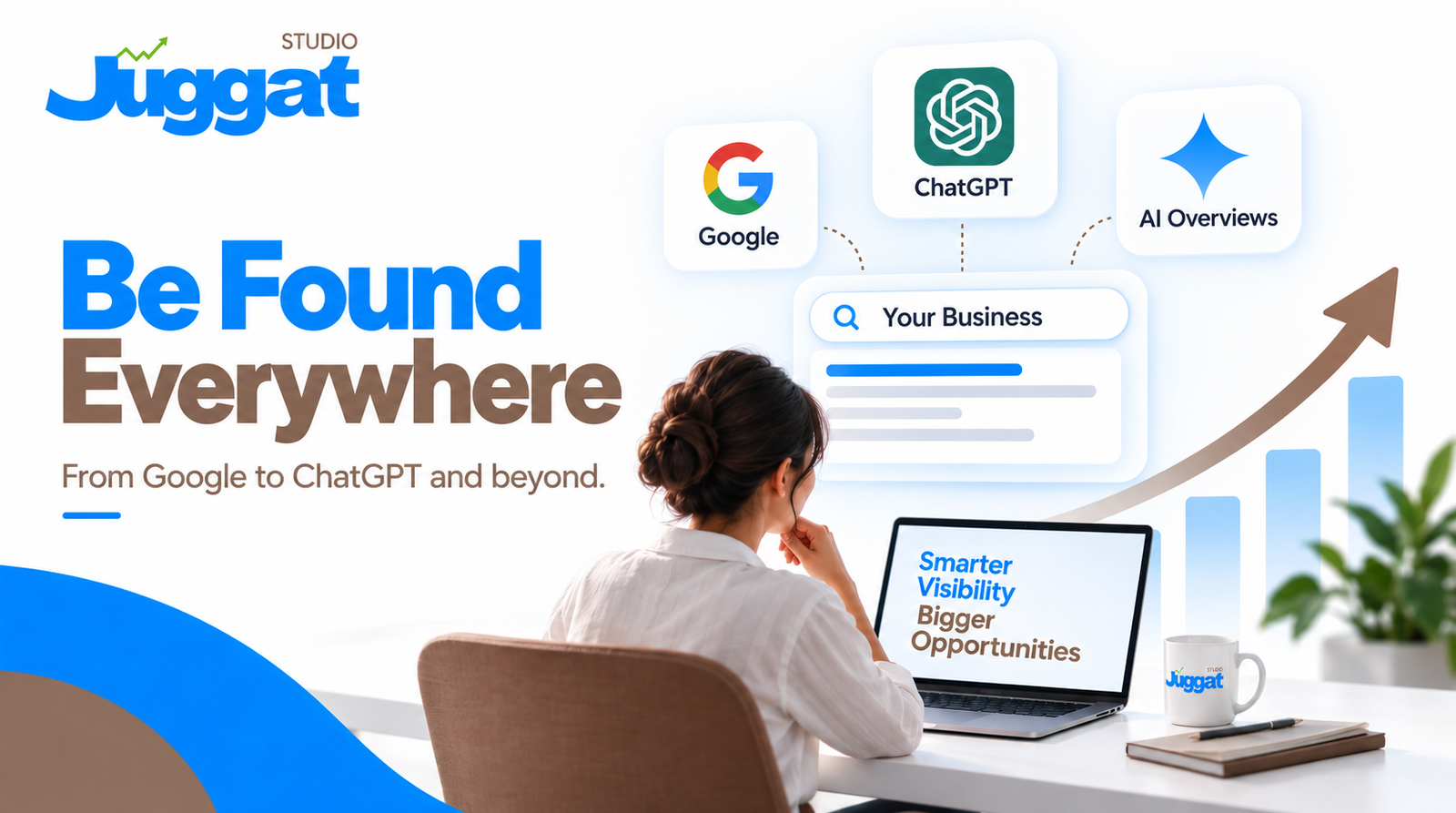
The short answer: You cannot submit your business to ChatGPT or guarantee a place in an AI-generated recommendation. But you can improve your chances by making your website easy to crawl, clearly explaining what you do, building credible third-party mentions, publishing useful content, keeping your business information consistent, and measuring the questions where your competitors appear.
The way people search is changing.
Instead of comparing ten Google results, a potential customer may now ask:
“Which SEO agency is best for AI search optimization?”
Or:
“Who can help my SaaS company appear in ChatGPT?”
ChatGPT, Google AI Overviews and Perplexity can then research multiple sources and produce a direct answer.
That changes the SEO question from “How do I rank?” to:
“How do I become a business these systems can find, understand and confidently mention?”
There is no guaranteed formula. But there is a practical way to improve your AI search visibility.
Why AI search visibility matters
Traditional SEO puts a lot of emphasis on rankings, impressions and clicks.
AI search adds another layer: mentions, citations and recommendations.
A business might be:
- Cited as a source
- Mentioned in an AI answer
- Included in a “best” list
- Recommended for a specific problem
- Used as an example
- Mentioned in a comparison
These aren’t exactly the same thing.
Being cited doesn’t automatically mean being recommended.
For example, ChatGPT might cite your article about ecommerce SEO without recommending your agency. That means your content has visibility, but your brand-level commercial visibility still needs work.
That distinction is one of the most important things businesses should understand about AI search.
How do ChatGPT, Google AI Overviews and Perplexity find businesses?
They don’t use one universal ranking system.
Google says AI Overviews and AI Mode are built on its existing Search systems, so traditional SEO fundamentals still matter. A page must be indexed and eligible for normal Search; there is no separate “AI Overview submission” or special AI schema.
ChatGPT Search uses multiple factors to surface relevant and reliable results, and OpenAI says websites should allow OAI-SearchBot to crawl content they want available in ChatGPT Search.
Perplexity searches across web sources, synthesizes the information and provides links to its sources.
So the common foundation is:
Crawlability → Relevance → Clarity → Authority → Evidence
1. Make your website discoverable first
Before worrying about GEO or AEO, check whether AI and search systems can actually access your content.
Check:
- Googlebot isn’t blocked
- OAI-SearchBot isn’t blocked
- Important pages are indexable
- Your sitemap is accessible
- Key pages are internally linked
- Your server returns successful responses
- Important content is available as text
- Your firewall/CDN isn’t blocking legitimate crawlers
OpenAI specifically recommends allowing OAI-SearchBot for inclusion in ChatGPT Search.
For Google AI features, Google recommends the same technical SEO foundations used for ordinary Search.
Don’t start with AI content if your technical foundation is broken.
2. Make your business easy to understand
AI needs to connect your:
Brand + service + audience + problem + expertise
Don’t rely on vague statements such as:
“We help brands grow in the digital world.”
Instead, clearly state:
“Juggat Studio is an AI-powered digital growth studio specializing in AI Search Optimization, SEO, Technical SEO, Local SEO, Ecommerce SEO, Content Marketing, Digital PR and Website Design & Development.”
Your homepage, service pages, About page, company profiles and important third-party listings should reinforce the same core identity.
This creates entity consistency.
3. Put the information buyers actually need on your website
This is a major gap in many AI-search guides.
Businesses often explain their services but leave out the information a customer needs before making a decision.
On important service pages, answer:
| Buyer question | What your page should provide |
| What do you do? | Clear service definition |
| Who is it for? | Industries/business types |
| What problem does it solve? | Specific pain points |
| What’s included? | Scope and deliverables |
| How does it work? | Process |
| How long does it take? | Realistic timeframe |
| How much does it cost? | Price or pricing approach where possible |
| Why trust you? | Experience, evidence, reviews |
| What results can I expect? | Realistic outcomes |
| How do I start? | Clear CTA |
You don’t need to reveal confidential pricing.
But if a buyer repeatedly asks AI, “How much does an AI SEO agency cost?”, a business with no useful pricing guidance gives AI less useful information to work with.
4. Create content around real buyer questions
Don’t build your AI-search strategy around endless “What is GEO?” articles.
Create content around decisions customers actually make.
For example:
- Why isn’t my business showing up in ChatGPT?
- How do I get my business recommended by ChatGPT?
- Is SEO still important for AI search?
- How do I measure AI search visibility?
- Why is ChatGPT recommending my competitors?
- How much does AI Search Optimization cost?
- How can a SaaS company improve AI visibility?
- How do I get cited by Perplexity?
This is where AEO and GEO become useful within a broader SEO strategy.
The objective isn’t to write for a machine.
It’s to answer the question better than the alternatives.
5. Build third-party evidence around your brand
This is one of the biggest areas competitors are now emphasizing—and one of the most important.
Your website says what you are.
Third-party sources help corroborate it.
Relevant sources can include:
- Industry publications
- Reviews
- Business directories
- Expert interviews
- Podcasts
- YouTube
- Comparison articles
- Industry associations
- Partner websites
- Relevant communities
- Digital PR coverage
Ahrefs’ analysis of 75,000 brands found strong correlations between ChatGPT visibility and YouTube mentions and branded web mentions, while its analysis of ChatGPT sources showed that third-party websites dominate many brand mentions.
That means brand authority outside your website matters too.
Don’t chase hundreds of random backlinks.
Build relevant evidence.
6. Find the websites AI already trusts
This is a smarter approach than simply building a list of “high-DA websites.”
Ask:
Which websites are ChatGPT, Perplexity and Google already citing for my target questions?
Then identify:
- Which competitors appear there?
- Which publications mention them?
- Which comparison pages include them?
- Which review platforms appear repeatedly?
- Which directories are frequently surfaced?
- Which YouTube channels discuss the category?
This creates a source-gap strategy.
If five competitors are repeatedly mentioned on a particular industry publication and your brand isn’t, that publication becomes a potential authority opportunity.
This approach is supported by Ahrefs’ research, which recommends working backward from the domains and pages ChatGPT already cites rather than guessing which websites matter.
7. Make your content easy for AI to extract
AI systems need to understand the answer quickly.
Use:
- Short paragraphs
- Question-based headings
- Direct answers
- Tables
- Bullets
- Definitions
- Examples
- Relevant statistics
- Clear conclusions
For example:
What is AI Search Optimization?
AI Search Optimization helps a business improve its visibility across AI-powered search experiences by making its content, entity information and authority signals easier for AI systems to discover, understand and cite.
Then expand on the definition.
This answer-first structure works for people as well as search systems.
Google also recommends clear, useful, people-first content and making important information available in textual form.
8. Don’t overlook Bing
This is a practical area many businesses miss.
If your goal includes ChatGPT visibility, don’t treat Google Search Console as your only search visibility check.
Also review:
- Bing Webmaster Tools
- Bing indexing
- XML sitemap submission
- Crawl errors
- Important pages in Bing’s index
Some current AI-search practitioners specifically recommend checking Bing indexing alongside Google because AI search ecosystems can use different retrieval sources.
The broader lesson is simple:
Don’t optimize for one search index when your customers are using several AI interfaces.
9. Build topical authority—not just individual articles
One article won’t establish your expertise.
If AI Search Optimization is a core service, build a connected content cluster:
Pillar
→ How to Get Your Business Recommended by ChatGPT, Google AI Overviews & Perplexity
Supporting articles
→ Why Your Business Isn’t Showing Up in ChatGPT
→ AI Search Optimization vs Traditional SEO
→ How to Measure AI Search Visibility
→ How to Get Cited by Perplexity
→ How Google AI Overviews Choose Supporting Sources
→ AI Search Optimization for SaaS Companies
Then connect these pages with internal links to your AI Search Optimization service and relevant SEO services on Juggat Studio.
This helps users move naturally from:
Problem → Education → Evaluation → Service → Contact
10. Measure AI visibility instead of guessing
You can’t improve what you don’t measure.
Create a list of 20–50 real buyer prompts.
For example:
“Best AI SEO agency for a SaaS company”
“Who can help my business appear in ChatGPT?”
“Best AI search optimization agency”
“AI SEO agencies for ecommerce”
Track:
| Metric | What it tells you |
| Brand mention rate | How often you’re named |
| Recommendation rate | How often you’re actually recommended |
| Citation rate | How often your content is cited |
| Competitor share | Who appears instead |
| Source share | Which sites influence answers |
| Accuracy | Whether AI describes you correctly |
Don’t test once and declare victory.
AI responses can change between queries. Ahrefs’ research also notes that ChatGPT doesn’t have conventional fixed rankings, so visibility across a set of relevant prompts is a more useful measurement than trying to claim “#1 in ChatGPT.”
Real-world evidence: Does this actually work?
There are already published case studies showing measurable movement, although results vary by site, industry and methodology.
Trust Insights
Trust Insights reported 1,066 AI referral sessions over six months, including traffic from ChatGPT, Perplexity, Claude and Gemini. It also reported 13 AI citations across Google AI Overviews, ChatGPT and Perplexity after starting from zero.
Read the Trust Insights AI visibility case study
Zerve / Rare Bird Lab
A published case study reported Zerve reaching #2 for AI visibility in its category, with citations from ChatGPT, Perplexity and Google AI Overviews. The approach combined direct answers, structured comparisons, technical credibility and traditional SEO.
Read the Zerve AI search visibility case study
What doesn’t work?
Be cautious of anyone promising:
- “Guaranteed #1 ranking in ChatGPT”
- A secret ChatGPT submission form
- Guaranteed AI Overview placement
- Hundreds of AI-generated articles as a shortcut
- Random backlinks for “GEO”
- Fake reviews or mentions
- A single schema type that guarantees AI visibility
Google explicitly says there are no special technical requirements or special schema needed for AI Overviews beyond normal Search eligibility and best practices.
OpenAI likewise says ChatGPT Search placement is not guaranteed.
The better strategy is straightforward:
Be accessible. Be clear. Be useful. Be corroborated. Be relevant.
AI Search Visibility Checklist
Before expecting AI systems to recommend your business, check:
- Website is indexable
- OAI-SearchBot isn’t unintentionally blocked
- Google and Bing indexing are healthy
- Core services have dedicated pages
- Business description is consistent
- Important facts are available in HTML
- Customer questions are answered directly
- Content demonstrates genuine expertise
- Structured data matches visible content
- Relevant third-party mentions exist
- Reviews and profiles are complete
- Competitor/source gaps have been identified
- AI visibility is tested with real buyer prompts
- Mentions, citations and recommendations are tracked
Frequently Asked Questions
How do I get my business recommended by ChatGPT?
You cannot guarantee a recommendation. Improve your chances by making your website crawlable, clearly explaining your services, building relevant third-party authority, publishing useful content and maintaining consistent business information across the web.
Can I submit my business to ChatGPT?
There is no standard business-submission form that guarantees inclusion in ChatGPT Search. OpenAI says public websites can appear in ChatGPT Search and recommends allowing OAI-SearchBot to crawl content you want discoverable.
How do I appear in Google AI Overviews?
Google says the same foundational SEO practices apply. Your page must be indexed and eligible for normal Google Search, while useful, original and people-first content remains important. There is no separate AI Overview optimization requirement.
How do I get my website cited by Perplexity?
Make your content accessible, relevant and easy to verify. Answer specific questions clearly, maintain strong topical authority and build credible third-party references. Perplexity’s search experience retrieves web sources and provides citations to the sources used.
Is SEO still important for AI search?
Yes. Google explicitly says its AI search features are grounded in its existing Search systems, so technical SEO, indexing, internal linking, useful content and other established SEO fundamentals still matter.
Ready to Improve Your AI Search Visibility?
Your customers are no longer limited to typing keywords into Google.
They may ask:
“Which company should I hire?”
And the answer may contain only a few businesses.
Juggat Studio helps businesses improve visibility across traditional search and AI-powered search through AI Search Optimization, SEO, technical SEO, content and digital PR.
Instead of guessing whether AI can find your business, start by finding out:
- Where your brand currently appears
- Which competitors are being recommended
- What sources influence those recommendations
- Which content gaps are holding you back
- Whether your website is technically accessible
- What authority signals your brand is missing
Want to know where your business stands?
Get an AI Search Visibility Assessment from Juggat Studio
Identify your visibility gaps, competitor mentions and opportunities to become more discoverable across the search experiences your customers are already using.
sds
sdssd
trtrrt
eererer
fddf